
Selecting the appropriate impeller for your overhead stirrer is crucial for achieving optimal mixing results. With various shapes, sizes, and materials available, the decision can be overwhelming. This article explores the key factors to consider when choosing an impeller, including vessel size, material viscosity, and desired flow patterns, to help you make an informed decision.
Key Factors to Consider
When selecting an impeller, several factors must be taken into account. These include the size of the vessel, the viscosity of the material, and the desired outcome of the mixing process. Additionally, the type of flow pattern—axial, radial, or tangential—plays a significant role in determining the effectiveness of the impeller.
Axial flow is ideal for top-to-bottom motion, suitable for stratification or solid suspension. Radial flow, on the other hand, is perfect for high-shear applications like emulsification or liquid-gas dispersion. Tangential flow, which moves fluid horizontally, is best for mixing high-viscosity materials. Understanding these flow patterns is essential for selecting the right impeller for your application.
Common Impeller Designs
Impellers come in various designs, each suited to specific applications. Below is a table summarizing the most common types of impellers and their characteristics:
| Type | Flow | Notes |
|---|---|---|
| Anchor Paddle | Tangential | Suitable for medium or high viscosity materials; used at low speed. |
| Pitched Blade Propeller | Axial | Balances shear and flow; used at high speed with medium- or high-viscosity materials. |
| Ring Pitched | Radial/Axial | Protects dip tubes or sensors; can be pitched or not. |
| Radial Flow | Radial | Best for low- or average-viscosity materials and average speeds. |
| Crossed Blade | Radial | Great for creating a vortex; effective for high-speed, low-viscosity applications. |
| Straight Blade | Radial | Good for high-speed, low-viscosity mixing; can create a vortex. |
| Blade Paddle | Tangential | For use at low or medium speeds; ideal for gentle mixing. |
| Dispersion Blade | Radial | Teeth break down agglomerations; provides very high shear. |
| Collapsible Blade | Radial/Axial | Ideal for narrow-necked vessels; can be pitched or not. |
| Half-Moon | Axial | For use with round-bottom vessels; collapsible for narrow-necked vessels. |
| Coil | Radial | Material is forced outward; ideal for dissolving powders. |
| Beater Paddle | Radial | Inhibits incorporation of air; ideal for stirring foaming liquids. |
| Chain Paddle | Radial | Suitable for narrow-necked vessels; used with low- and high-viscosity liquids. |
Impeller Size and Material
The size of the impeller is critical for effective mixing. It must fit within the vessel and be large enough to incorporate the entire contents. For radial or axial flow, the impeller diameter should be about one-third of the vessel diameter, while anchor or paddle impellers should be around 90% of the vessel diameter. Using an impeller that is too large can obstruct the re-circulation path, inhibiting proper mixing.
Material selection is equally important. While most impellers are made from metal, PTFE-coated impellers are ideal for corrosive materials. Glass impellers, such as those from Troemner, are suitable for sensitive samples. For more information on impeller materials, visit Wikimedia’s category on magnetic stirrers.
Video Demonstration
For a practical guide on selecting and using impellers, watch the following video:
Recommended Equipment
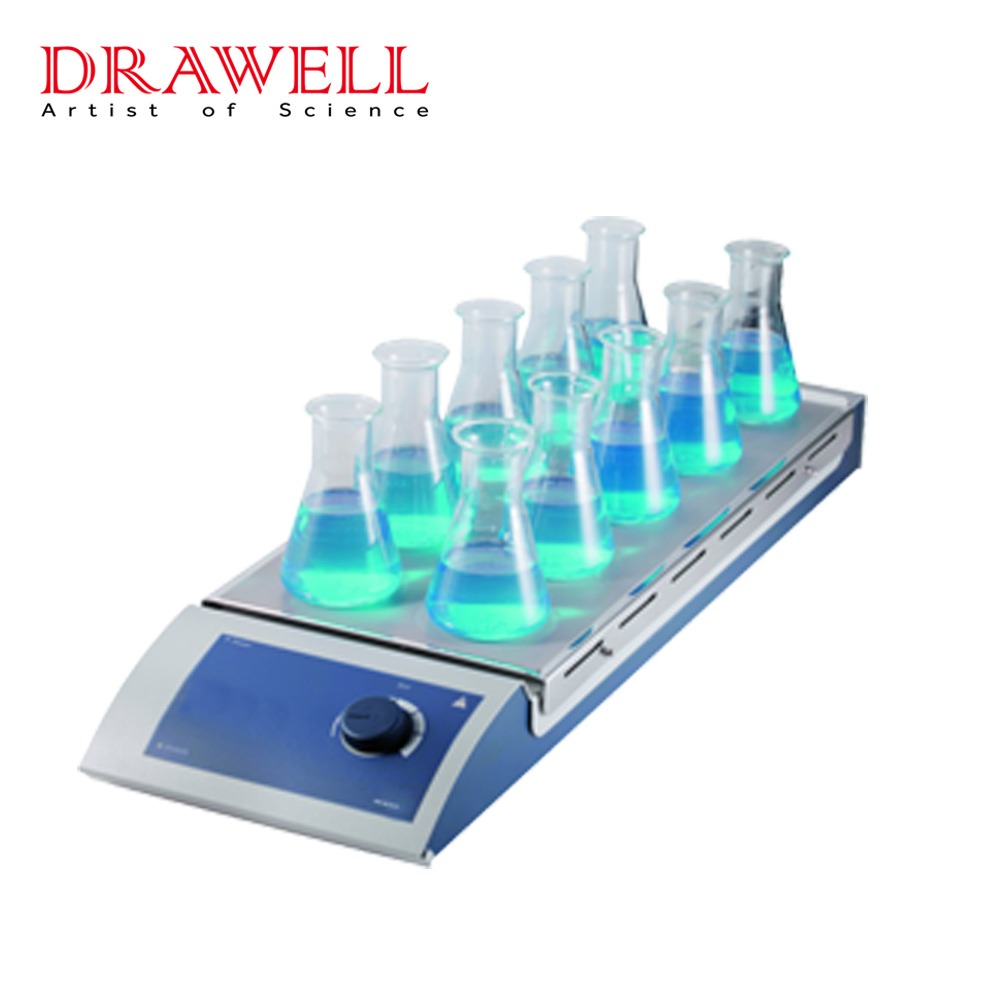
For laboratories seeking a reliable and versatile stirrer, the 10-Channel Classic Magnetic Hotplate Stirrer MS-H-S10 is an excellent choice. Its robust design and advanced features make it suitable for a wide range of applications.
Conclusion
Selecting the right impeller for your overhead stirrer involves careful consideration of vessel size, material viscosity, and desired flow patterns. By understanding these factors and choosing the appropriate impeller design and material, you can achieve efficient and effective mixing. For applications requiring precise temperature control, a heated magnetic stirrer may also be a valuable addition to your laboratory setup.